<!DOCTYPE html>
Avoid the Mess of Digging with Trenchless Technology
Avoid the Mess of Digging with Trenchless Technology
Homeowners in Sherman Oaks value quiet streets, mature landscaping, and well-kept driveways. They also live with aging sewer laterals made of vitrified clay pipe and cast iron. That mix invites root intrusion, corrosion, and recurring backups. Trenchless sewer repair solves these problems without trench scars through lawns, pavers, or pool decks. ServiStar Plumbing and HVAC delivers this work in Sherman Oaks and the greater San Fernando Valley with licensed crews and high-grade materials that stand up to demanding soils and daily use.
This article explains how trenchless technology works on local homes and small commercial properties. It covers symptoms, materials, the steps, and how crews protect patios and structures on hillsides. It also shows how a free sewer camera inspection connects symptoms in the home with the exact defect in the line. The focus is on neighborhoods along Ventura Boulevard and the slopes above it, including Sherman Oaks Hills, Longridge Estates, and Royal Woods, with service coverage in 91403, 91423, 91411, and 91495.
Why trenchless repair fits Sherman Oaks properties
Sherman Oaks sits on old riverbed soils near the Sepulveda Basin and layered fill on the hills. Many homes have sewer laterals installed between the 1940s and 1970s. Clay joints open over time. Cast iron scales from the inside. Orangeburg pipe appears on a few mid-century lots and tends to deform under load. These materials show their age by letting in roots, causing bellies, and leaking at joint connections. Digging through hardscaping and mature ficus, magnolia, and jacaranda roots raises the cost and risk. A no-dig method reduces those risks. It also shortens downtime for kitchens and bathrooms that run on a tight daily schedule.
Residents near Westfield Fashion Square and the Sherman Oaks Galleria often protect decorative concrete, imported tile, or rare plantings. A trench carve across those surfaces means long restoration delays. Trenchless CIPP lining or pipe bursting inserts a structural repair through small access points, usually at the cleanout or a short pit near the property line or manhole. The method keeps driveways intact on busy blocks off Ventura Boulevard and preserves curb appeal on quiet courts in Hidden Woods or Chandler Estates.
Local symptoms that point to a trenchless fix
Most calls start with slow drains or backups after rain in the Sepulveda Basin area or after heavy irrigation cycles in Sherman Oaks Hills. The main sewer line is the common bottleneck. Root intrusion through clay joints forms a dense mass at 30 to 80 feet out. Cast iron lines develop heavy scale and tuberculation that catch grease from the kitchen drain and paper from the floor drain or toilet. A bellied pipe traps wastewater that ferments and gives off a sewage odor in side yards. Gurgling toilets are a classic sign that the vent path is obstructed by a partial block downstream. Foundation leaks or small sinkholes can show up near old joint connections that leak into loose soils.
A short story from Longridge Estates makes the case. A homeowner noticed lush grass over a narrow band that crossed an otherwise dry lawn. Backups hit the first-floor bath every few weeks. A Ridgid HD camera showed a crack at 54 feet in a vitrified clay pipe section with several offset joints. Hydro jetting cleared the roots for the camera pass. The team lined the run using a CIPP epoxy resin system and reinstated three service connections. The lawn stayed intact. The driveway near the cleanout remained untouched. The main line has run clear since.
How a free sewer camera inspection isolates the problem
ServiStar starts with a free sewer camera inspection for homeowners in 91403 and 91423. The crew uses Ridgid camera technology with a sonde locator to map the run, depth, and defects. The video shows root intrusion, cracks, corrosion, and bellies with timestamps and distance readings. It also confirms the pipe material, which matters for the repair plan. Vitrified clay pipe often shows open joints and root growth. Cast iron shows scale and thinning. Orangeburg pipe looks distorted. The locator tracks the line under driveways, patios, and retaining walls so the team can plan access without surprises.
The inspection also checks the cleanout condition and the toilet flange drops. It looks for sagging at the transition from the house to the yard. It confirms the tie-in at the city main, which might be across an easement or near a manhole on an alley in Van Nuys or Studio City. In some streets off Magnolia Woods and Royal Woods, the main runs deeper, and the lateral has a sharp bend near the curb. The video reveals that bend and helps decide if pipe bursting or CIPP lining is the right move. The technician explains the footage in plain terms and shares a link. That record helps with financing and HOA approvals where needed.
Trenchless methods used in Sherman Oaks
ServiStar selects the method that fits the defect, the access, and the surface risks. The main options are CIPP lining, pipe bursting, and sectional point repair. Hydro jetting and pipe descaling serve as prep steps so the new liner bonds to a clean wall and the camera can inspect without debris.
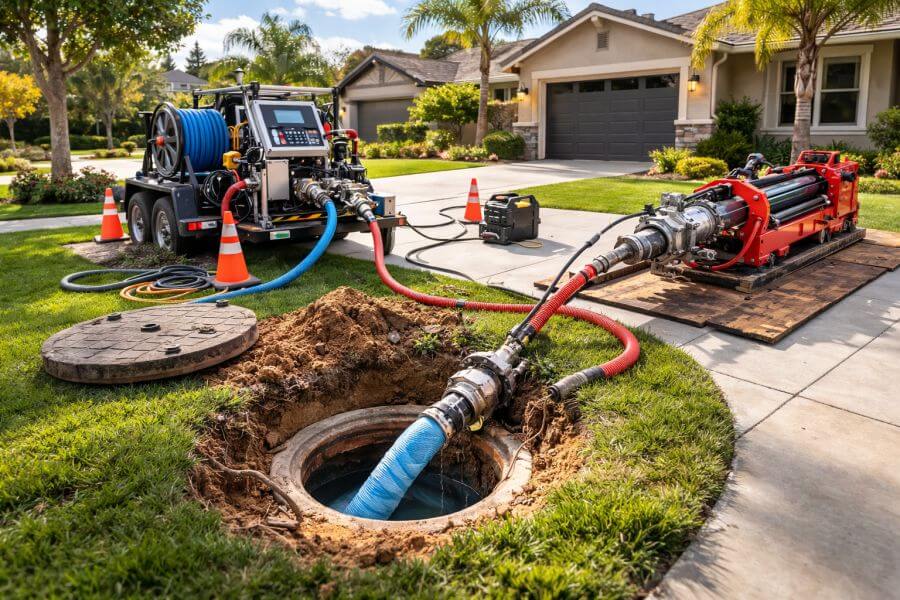
CIPP, also called cured-in-place pipe, inserts an epoxy liner through the existing sewer lateral. A calibration tube presses the resin-saturated tube against the wall of the host pipe. The resin cures into a seamless, structural pipe. This turns a leaky clay run into a smooth, reinforced line with no joints. It blocks root intrusion and resists corrosion. Perma-Liner and NuFlow are two premium systems used on local jobs. The choice depends on pipe diameter, length, and service reinstatement needs. For 4 to 6-inch residential laterals common in Sherman Oaks, a single-shot liner often covers the run from the cleanout to the city connection.
Pipe bursting replaces fragile pipe with a new HDPE pipe. A bursting head fragments the old clay or Orangeburg as a winch pulls in a continuous HDPE section. The new pipe has heat-fused joints or is a single length, which gives a long service life. HammerHead Trenchless equipment is used for controlled bursting where the line has severe deformation or collapse. Bursting suits runs with many bellies or sections that have lost shape and cannot accept a liner.
Sectional point repair fixes a localized defect, such as a crack under a driveway panel or at a single bad joint. A short epoxy liner cures right over the damaged zone. This option avoids full-length work if the rest of the lateral is sound. It is common under paver walkways along Ventura Boulevard stores and small office fronts, where only one root intrusion point causes the trouble.
Hydro jetting uses high-pressure water to clear roots, grease, and sludge. It prepares the surface for lining. It also restores flow right away for homes with guests or active businesses along Ventura Boulevard. For heavy cast iron scale, Picote descaling machines scrape and grind the interior, then a jet flushes the debris. That step improves final liner adhesion. IMS Robotics cutters help reinstate branch connections and trim liner edges with precision.
Materials that matter: epoxy, HDPE, and fittings
Epoxy resin lining is the heart of CIPP. The resin wets out the felt or fiberglass liner and cures to a hard, smooth interior. It resists chemicals often found in household waste and cleaning agents. The calibration tube applies even pressure during cure. The result mimics the inner surface of new HDPE-quality pipe. In many cases, the lined pipe achieves a 50-year pipe lifespan rating by the manufacturer when installed to spec and inspected to IAPMO standards. The new surface also reduces friction loss, which supports better flow even with low-slope segments that are common on flat lots near Van Nuys Sherman Oaks Park.
HDPE pipe used in bursting takes strain well and bends through gentle curves without joints. Fused sections create a monolithic run. That eliminates leak-prone connection points. The connection at the city main uses an approved saddle or coupling, secured per Los Angeles County code. Inside the property, transitions to existing cast iron or ABS use shielded couplings set behind a cleanout with proper torque on the band clamps. All joint connections are checked by camera before closing pits.
The cleanout location matters. Many Sherman Oaks homes have a cleanout near the driveway apron. Others have it behind a hedge line. If there is no cleanout, the crew can install one with minimal impact and tight layout to meet code. A correct cleanout makes future inspections and maintenance easier. It also allows easy jetting if a kitchen drain sends grease downstream again. ServiStar documents the final locations for homeowners and property managers.
Workflows that keep hardscaping and slopes safe
Driveways in Sherman Oaks often use stamped concrete or rare pavers. On hillside streets like Deervale-Stone Canyon Park access roads, slopes and retaining walls add pressure and risk. ServiStar uses narrow access pits, plywood shoring, and load-spread mats to protect surfaces. Any pit sits outside setback distances from footings where possible. Where the line passes under a retaining wall, crews use lining instead of bursting to avoid lateral soil movement.
On Ventura Boulevard corridors with storefronts, after-hours work limits disruption. Short cure times help open restrooms and kitchens the same day. On single-family homes with kids and pets, the team cords off the area and keeps hoses and cables tidy. The sequence is hydro jetting, camera confirm, descaling as needed, a second camera pass, then CIPP install or bursting. A final camera video serves as the completion record. It also supports warranty service if a future clog occurs due to a foreign object or a shifted toilet flange connection.
How trenchless repairs interact with home fixtures and drains
Homeowners often ask how this work affects the toilet flange or branch lines. A correct liner installation does not disturb the toilet flange. The main sewer line repair happens downstream of interior branches. During reinstatement, cutters open the liner where kitchen drain and floor drain connections tie in. The opening remains smooth and flush. That prevents snag points. Sump pump and ejector pump discharges in lower-level additions also get checked during the camera pass. Flow rates and angles are tested after the liner cures to confirm that all appliances drain cleanly.
The crew tests every flushing fixture in the home, including powder room toilets, garage utility sinks, and bar sinks. It also tests laundry discharges that send lint and soap. These test runs reveal any lingering slow drains so corrections happen before demobilization. If a homeowner plans a bathroom remodel, the video map helps the general contractor avoid saw cuts in the wrong spots.
Choosing between CIPP lining and pipe bursting
The choice hinges on three things. First, the shape and stability of the host pipe. Second, the need to protect an area where soil movement is risky. Third, the number of bends and tie-ins. A stable host pipe with cracks and root intrusion lines up well for CIPP. A flattened Orangeburg or a clay line with long bellies tends to favor pipe bursting. Multiple bends near mature tree roots might also tip the choice toward lining to avoid pulling a bursting head through tight arcs.
Costs run in ranges. A short CIPP from 30 to 60 feet often falls below a full dig-and-replace by 20 to 40 percent when hardscape restoration is part of the scope. Pipe bursting can match or beat CIPP costs when access pits are easy and the run is straight. Sectional point repair is the lowest cost if a single defect is the cause. ServiStar lays out the options in plain numbers with line-item notes. Financing options are available for homeowners who want to spread the cost while work proceeds right away.
Diagnostic precision with brand-grade tools
Diagnostic quality drives a good outcome. ServiStar uses Ridgid cameras to capture sharp video in 4 to 6-inch lines. For blockages that resist a jet, Picote cutting heads open a path. For premium installations, Perma-Liner and NuFlow systems provide reliable epoxy chemistry and reliable cure profiles. HammerHead Trenchless gear supports controlled pipe bursting. IMS Robotics cutters reinstate branch lines to clean edges. Every tool in the chain aims to reduce future callbacks and extend the usable life of the repair. Materials and equipment meet IAPMO certified standards, and field teams hold C-42 Sanitation System Contractor licensing for Los Angeles County work.
Some homeowners ask about do-it-yourself rentals from Home Depot or Lowes. Those can help with minor clogs near the fixture. They do not solve defects in the sewer lateral. Attempted snaking of a root-choked clay run often punches through a weak spot, which enlarges a crack. A professional camera survey prevents guessing. It also logs depth and slope. That data supports technical choices that keep the property intact.
Local mapping and access planning
Streets near Ventura Boulevard, Beverly Glen, and Coldwater Canyon see dense utility corridors. Gas, water, and telecom lines zigzag across front yards. A careful locate prevents cross-utility impacts. ServiStar crews pull permits where needed and coordinate with the city on cleanout-to-sewer connections near manholes. On cul-de-sacs in Royal Woods and Longridge Estates, access sometimes runs across shared easements. The crew maps that route and notifies neighbors if access affects shared drives.
In 91411 and 91495 work zones near light commercial buildings, the process often includes night scheduling. Restaurants along Ventura Boulevard need kitchen drain uptime for service hours. Small offices near Sherman Oaks Galleria need bathrooms open by morning. Trenchless lining meets those schedule constraints. The team can jet and line after close, cure overnight, and test before open.
Soil, slope, and structural notes specific to Sherman Oaks
Soils near the Sepulveda Basin hold moisture and can soften. Bellied pipe sections appear in those zones after heavy rain. Up in Sherman Oaks Hills and Deervale-Stone Canyon Park, slopes put extra shear on joints where the lateral passes under retaining walls and stair landings. CIPP lining adds ring stiffness and resists shear at joint lines. Pipe bursting on a slope needs careful pit placement and controlled pull speeds. Load-spread mats protect pavers on patios with views above the valley. The crew uses compact winches and staged pulls to avoid shocks on bends.
Many homes in Chandler Estates and Hidden Woods sit on older foundations where the lateral exits near the footing. Camera locates confirm that exit so any pit sits clear of the structure. Any foundation leaks seen during inspection are noted for the homeowner. If needed, a point repair can seal a leak under a driveway without cutting concrete. That is common where an old clay hub joint sits under a stamped concrete ribbon that the owner wants to keep untouched.
From symptom to solution: a quick decision path
Most homeowners want a quick way to decide. The flow goes like this. If multiple fixtures back up and there is a sewage odor outside, the main sewer line likely has root intrusion. If toilets gurgle after showers, look for a partial block that holds air in the line. If there is a lush patch over the route to the street, a crack or offset joint is leaking. The free camera inspection confirms the location and the material. Hydro jetting clears roots for a clean view. Then the proposal shows a CIPP liner or pipe bursting plan with access points and cure time. The crew schedules work within days, not weeks, and restores service the same day in many cases.
A short comparison of trenchless options
- CIPP pipe lining: best for cracks, roots, moderate offsets, and stable host pipe. Fast cure. Minimal pits. Uses epoxy resin and a calibration tube.
- Pipe bursting: best for deformed Orangeburg, severe bellies, or collapsed clay. Requires entry and exit pits. Installs continuous HDPE pipe.
- Point repair: best for a single defect under a driveway or patio. Short liner segment. Quick return to service.
- Hydro jetting and descaling: prep steps for lining. Also used as maintenance on heavy kitchen grease lines.
- Camera and locate: needed in every case to measure length, depth, and tie-ins. Uses Ridgid equipment and on-screen distance count.
Quality control and codes
C-42 licensing and IAPMO certified practices set the baseline. The city connection uses code-approved saddles or couplings. The liner meets thickness specs for the pipe diameter and load class. Cure logs record time, temperature, and pressure. The final camera pass documents reinstated branches from the kitchen drain, floor drain, and any ejector pump line. The crew labels the cleanout cap with the date and method used. The homeowner receives the video file, still images of key points, and the warranty record. ServiStar backs the work with a clear warranty period and a service path if a problem appears.
Maintenance after trenchless repair
A lined pipe or a new HDPE run reduces maintenance by cutting snag points and sealing joints. Homeowners can help by keeping wipes, dental floss, and grease out of the line. If a large family fills the house near Ventura Boulevard, a yearly jet service may help, especially if the kitchen drain sees heavy use. ServiStar offers maintenance programs that include a quick camera look and hydro jetting as needed. That keeps performance high and tracks any changes at the city tie-in.
Service footprint and proximity signals
ServiStar provides trenchless sewer repair in Sherman Oaks zip codes 91403, 91423, 91411, and 91495. The team works daily near Ventura Boulevard, Westfield Fashion Square, the Sherman Oaks Galleria, and Van Nuys Sherman Oaks Park. Crews also handle calls from nearby Encino, Studio City, Valley Village, Van Nuys, Bel Air, and Beverly Crest. That proximity reduces travel time and supports fast response. Local knowledge of street grades, easement routes, and older tract maps reduces guesswork on line paths under yards and drives.
Common questions from Sherman Oaks homeowners
How long does a liner install take? Most jobs complete within one day. Setup, jetting, and lining run a few hours. Cure time depends on resin and method. Many liners cure in place within 2 to 4 hours. Some steam cures run faster. How long will it last? When installed to spec, a CIPP liner or HDPE run can match a 50-year pipe lifespan rating based on lab and field data. What if there are many bends? The camera survey counts angles. If bends exceed safe limits for bursting, the plan shifts to CIPP. If bends are sharp for lining, a sectional approach or a short dig may be noted at that point only.
Will the work affect the landscaping? Access pits are small and set in low-impact zones. Mats and boards spread loads to protect grass and pavers. Where roots from oaks or magnolias cross the line, the plan uses lining to avoid cutting them. Can a liner handle a small belly? A liner follows the host pipe shape. It does not remove a deep belly. If the belly holds water, bursting or a short dig may be the right call. The crew explains these trade-offs with camera footage on screen.
Technical case notes from recent Sherman Oaks projects
Royal Woods slope line, 4-inch clay to 6-inch city main. Symptoms: recurring backups and gurgling toilets. Camera: roots at 48 feet and a cracked hub at 52 feet. Prep: hydro jetting, Picote chain knocking light scale at the cast iron transition. Method: Perma-Liner CIPP from 5 feet to 56 feet. Reinstated one kitchen branch. Result: smooth flow, no odor. Driveway and hedges intact.
Ventura Boulevard mixed-use building, 6-inch Orangeburg under parking. Symptoms: slow drains after lunch rush. Camera: deformed pipe at 22 to 30 feet, standing water. Method: HammerHead Trenchless bursting to install 6-inch HDPE. Night work window. Result: bathrooms open by 7 a.m. No surface demo beyond two small pits. Owner note: planned repave delayed until next year, not forced by the repair.
Longridge Estates single defect, clay lateral under flagstone walk. Symptoms: sewage odor near entry steps. Camera: single crack at 12 feet. Method: sectional point repair using epoxy liner packer. Result: odor gone, stones untouched. Time on site: under four hours.
How trenchless sewer repair compares to full excavation on cost and risk
Full excavation can expose the entire lateral. It also demands permits, days of trenching, and full hardscape restoration. On Sherman Oaks lots with decorative surfaces, that adds thousands in restoration. It also risks utility strikes and soil movement near foundations. Trenchless limits excavation to small access points and a cleanout upgrade where needed. The repair cost becomes predictable. The risk of collateral damage drops. The result is a renewed main sewer line with fewer open variables after the crew leaves.
Entity-focused clarity for decision makers
The core service is trenchless sewer repair with CIPP, pipe bursting, sewer lateral lining, and sectional point repair. Common problems include root intrusion, cracked sewer pipe, bellied pipe, pipe corrosion, sewer backup, slow drains, sewage odor, gurgling toilets, foundation leaks, and sinkholes. Key components are the sewer lateral, cleanout, HDPE pipe, epoxy liner, calibration tube, manhole, joint connections, cast iron pipe, vitrified clay pipe, and Orangeburg pipe. Fixture types include the main sewer line, kitchen drain, floor drain, toilet flange, sump pump, and ejector pump. The geographic focus is Sherman Oaks, CA, covering 91403, 91423, 91411, and 91495 with nearby Van Nuys, Studio City, Encino, Valley Village, Bel Air, and Beverly Crest. The brand stack includes Ridgid cameras, Perma-Liner and NuFlow CIPP systems, Picote descaling tools, HammerHead Trenchless bursting, and IMS Robotics cutters. Trust attributes include 24/7 emergency service, free sewer camera inspection, licensed C-42 sewer contractor status, IAPMO certified practices, no-dig technology, 50-year pipe lifespan claims from manufacturers, and financing options.
Quick homeowner checklist before scheduling
- Note the symptoms: backups in multiple rooms, sewage odors outside, or gurgling toilets after showers.
- Find the cleanout: near the driveway, side yard, or planter by the curb. Clear access.
- Mark surface risks: pavers, stamped concrete, pool decks, or roots along the route to the street.
- Confirm address and zip code: service routes cover 91403, 91423, 91411, and 91495.
- Set a time for the free camera inspection: allow 60 to 90 minutes for jetting, video, and a written plan.
Why residents choose ServiStar for trenchless sewer repair in Sherman Oaks
Residents see a mix of technical depth and local awareness. The team understands how tree roots from mature landscaping invade clay joints. It knows where older cast iron runs under driveways near Ventura Boulevard and how a bellied pipe hides under lawn strips. Technicians show video proof with Ridgid cameras. They explain the difference between CIPP and pipe bursting and why one suits a line under a magnolia bed and the other suits a flattened Orangeburg under a parking bay. They use Perma-Liner or NuFlow systems for premium CIPP, Picote tools for descaling, HammerHead Trenchless for bursting, and IMS Robotics for reinstatements. Work follows IAPMO standards and the crews hold C-42 licensing. Service is available 24/7 for emergencies. A free sewer camera inspection removes guesswork. Financing options help homeowners act now rather than push repairs into the next season.
Competitors like Roto-Rooter may offer basic clearing. Sherman Oaks homes benefit from a trenchless plan that solves the root cause. The aim is a structural repair that protects property value on high-end streets like Longridge Estates, Royal Woods, and Sherman Oaks Hills. The outcome is a renewed line, clean landscaping, and quiet comfort inside the home.
Google Map Pack signals and local verification
Local presence matters. ServiStar logs many completed projects within a two-mile radius of Ventura Boulevard and the Sherman Oaks Galleria. Jobs near Westfield Fashion Square and Van Nuys Sherman Oaks Park confirm proximity. Reviews reference zip codes 91403 and 91423 and mention successful fixes for root intrusion in clay pipes and corrosion in cast iron. Photos show small access pits, clean work zones, and before-and-after camera shots of lined pipes. These signals help residents and property managers verify that the company performs trenchless sewer repair Sherman Oaks wide, day after day.
Scheduling sewer repair in Sherman Oaks without delays
Fast action reduces the chance of a full collapse or a sinkhole near the curb. Same-week scheduling is common. The first step is the free sewer camera inspection. The second step is a clear proposal with the method, materials, and timeline. The third step is the repair with CIPP, pipe bursting, or point repair, plus hydro jetting and descaling as needed. The final step is a documented camera walkthrough and a clean site. Homeowners in 91403, 91423, 91411, and 91495 can book day or night, including 24/7 emergency service for active backups.
Clear, simple terms that match homeowner goals
The main goal is to stop backups and protect property without digging up the yard. Trenchless technology achieves that. CIPP lining seals cracks and joints with epoxy resin. Pipe bursting replaces failing pipe with continuous HDPE. Sectional point repair handles a single defect. Hydro jetting and Picote descaling prepare the line. Ridgid cameras and IMS Robotics tools guide and verify the work. The result is a long-life pipe with smooth flow. The driveway, patio, and plantings remain in place.
trenchless sewer repair Sherman Oaks
Servistar Plumbing and HVAC
13351 Riverside Dr Suite #414
Sherman Oaks,
CA
91423
Phone: (818) 873-0613
Website: servistarplumbingandhvac.com